
Many years ago, I learned an important lesson.
.
When we create an idea, a business, a system, or even a belief, we naturally become attached to it.
.
We begin to see its strengths.
We imagine its possibilities.
We focus on what could go right.
.
But reality has a different role.
.
Reality tests every assumption.
.
One of the most valuable questions we can ask is:
"Why might this fail?"
.
Not because we want it to fail.
.
But because understanding weaknesses is often the fastest path to improvement.
.
In engineering, structures are tested before they are trusted.
.
In science, theories are challenged before they are accepted.
.
In business, ideas should be criticised before they are scaled.
.
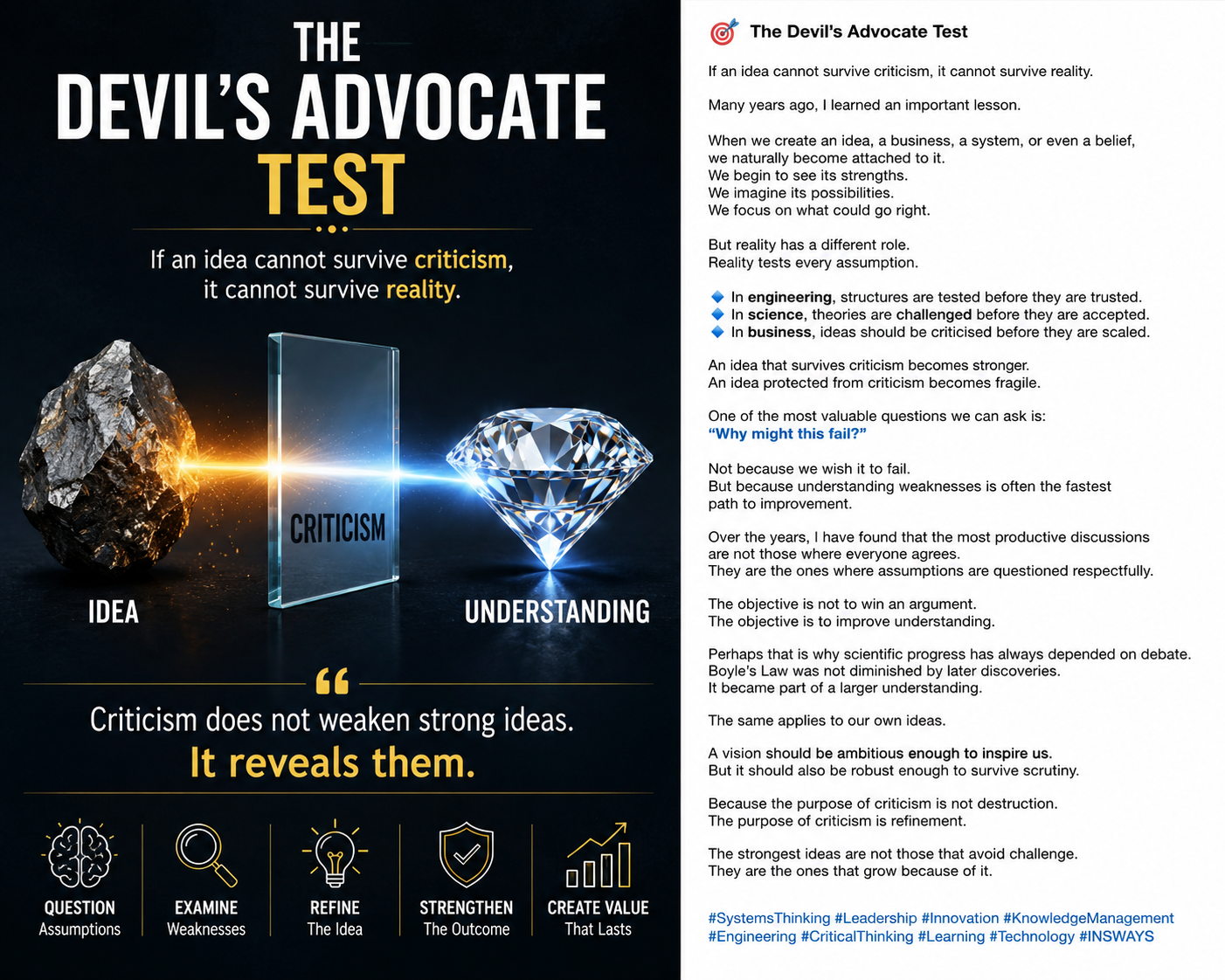
An idea that survives criticism becomes stronger.
.
An idea protected from criticism becomes fragile.
.
Over the years, I have found that the most productive discussions are not those where everyone agrees.
.
They are the ones where assumptions are questioned respectfully.
.
The objective is not to win an argument.
.
The objective is to improve understanding.
.
Perhaps that is why scientific progress has always depended on debate.
.
Boyle's Law was not diminished by later discoveries.
.
It became part of a larger understanding.
.
The same applies to our own ideas.
.
A vision should be ambitious enough to inspire us.
.
But it should also be robust enough to survive scrutiny.
.
Because the purpose of criticism is not destruction.
.
The purpose of criticism is refinement.
.
The strongest ideas are not those that avoid challenge.
.
They are the ones that grow because of it.
.
Criticism does not weaken strong ideas.
It reveals them.
.