
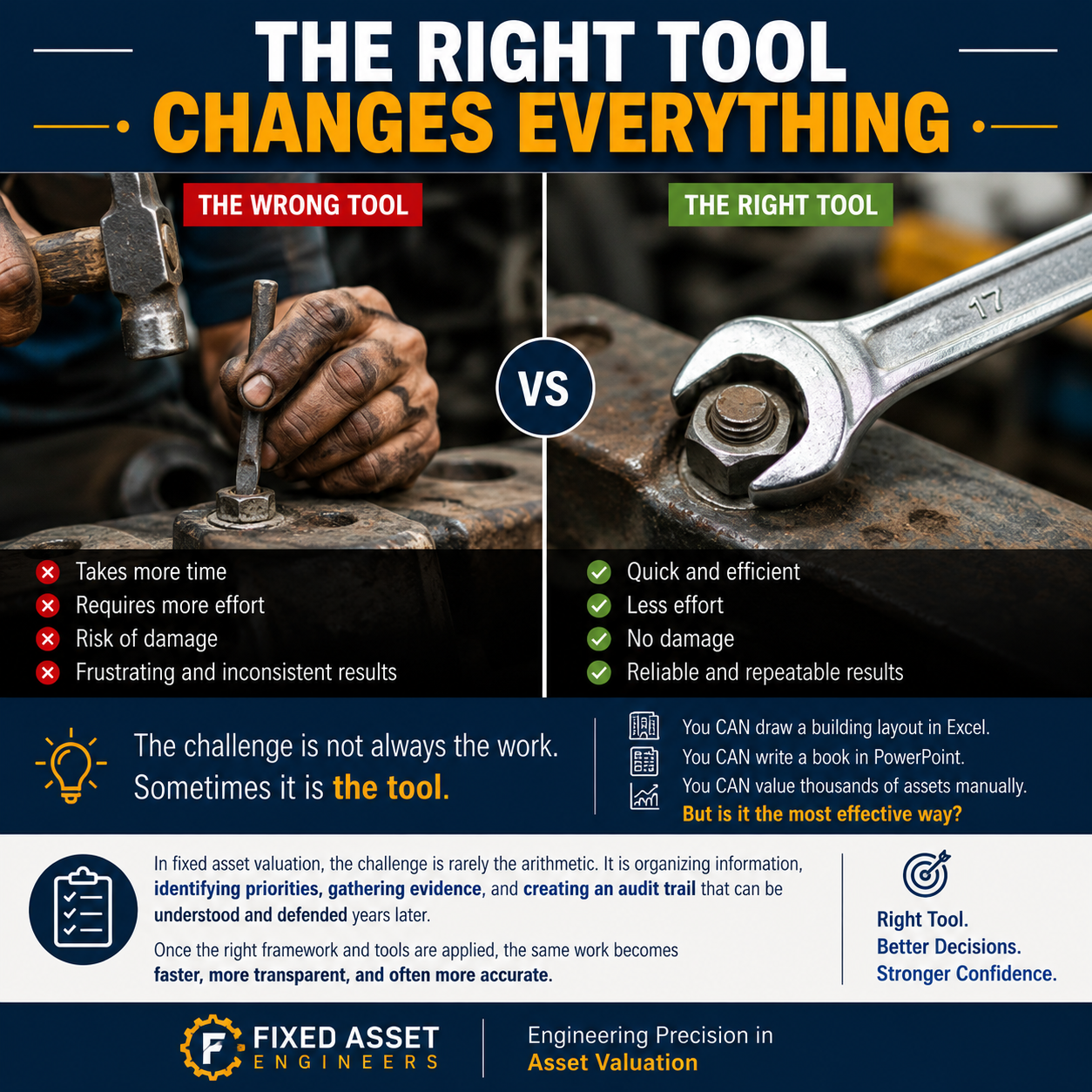
Growing up in India, I often watched roadside mechanics perform remarkable repairs with very limited tools.
Sometimes, a stubborn nut would be loosened using a hammer and a chisel because the correct spanner was not available.
The job got done.
But it took more time.
More effort.
And occasionally damaged the nut in the process.
•
That observation stayed with me.
Many professional problems are not difficult because they are complex.
They are difficult because we are using the wrong tool.
•
You CAN draw a building layout in Excel.
You CAN write a book in PowerPoint.
You CAN calculate reinstatement values for thousands of fixed assets manually.
The question is not whether it can be done.
The question is:
"Is it the most effective way to do it?"
•
In fixed asset valuation, the challenge is rarely the arithmetic.
The challenge is organizing information.
Identifying priorities.
Gathering market evidence.
Creating an audit trail that can be understood and defended years later.
•
Recently, while working on a large technology asset portfolio, one simple observation stood out.
A relatively small number of asset groups represented the majority of the total asset value.
Once those groups were identified and prioritized, the valuation process became clearer, faster, and more evidence-based.
•
The lesson applies far beyond valuation.
Whether in engineering, finance, technology, manufacturing, or business...
Productivity often improves not because people work harder.
It improves because they finally find the right tool for the job.
•
The challenge is not always the work.
Sometimes it is the tool.
•
What is one example in your profession where using the right tool completely changed the outcome?