
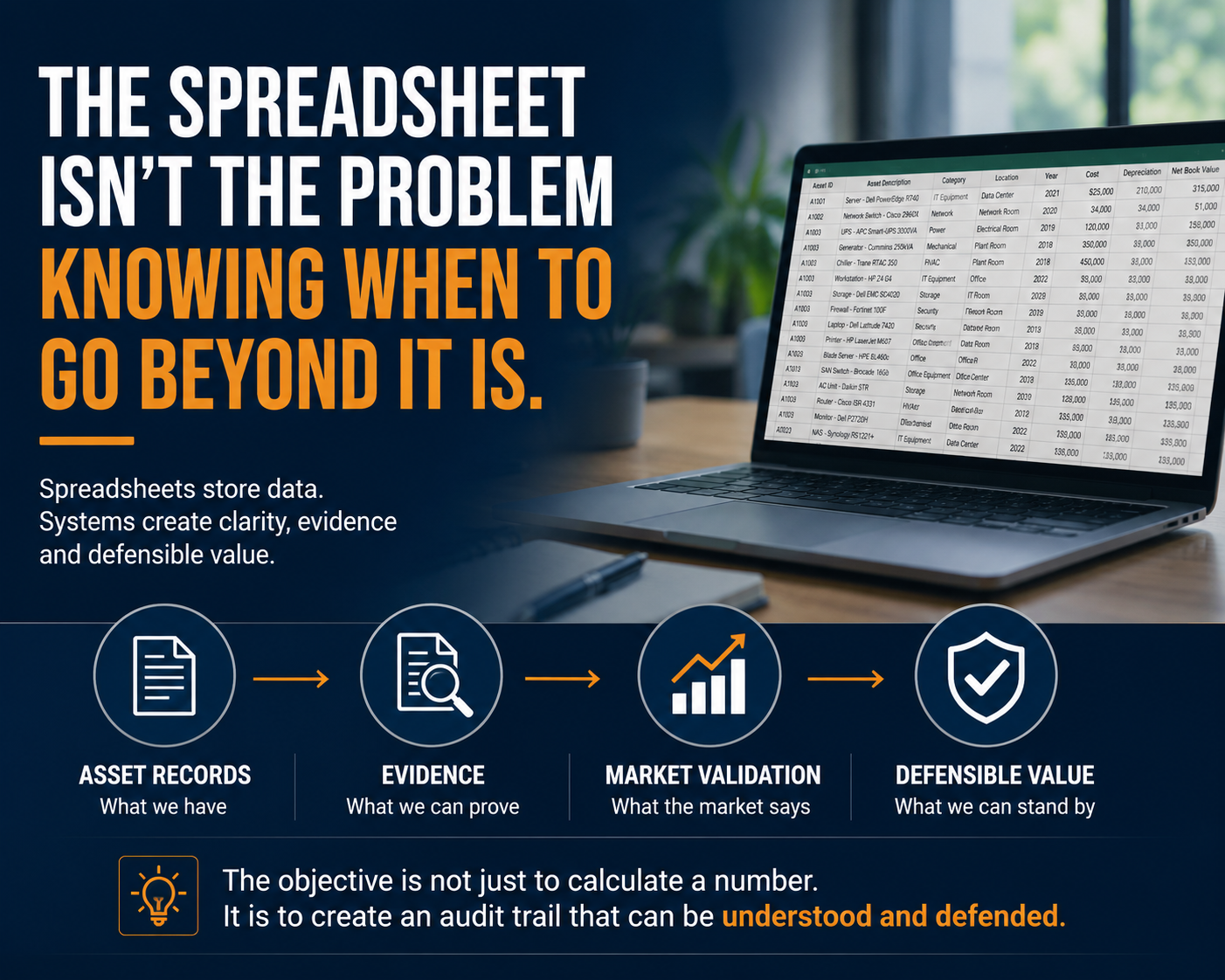
I have spent much of my professional life working with Fixed Asset Registers, reinstatement valuations, insurance reviews, and claim investigations.
.
One observation continues to surprise me.
.
Many asset-related challenges remain invisible because the existing process appears to work reasonably well.
.
A spreadsheet can store thousands of asset records.
.
It can calculate totals.
.
It can sort, filter, and summarize.
.
And therefore, it creates a comforting impression that the problem has already been solved.
.
But sometimes the real question is not:
.
"Can we store the data?"
.
The real question is:
.
"Can we understand, validate, and defend the value represented by that data?"
.
A road-side mechanic can loosen a nut with a hammer and chisel.
.
It works.
.
But nobody would argue that it is the best tool for the job.
.
In the same way, spreadsheets are excellent tools for many purposes.
.
The challenge begins when we ask them to perform tasks that require relationships, evidence trails, prioritization, traceability, and long-term defensibility.
.
The issue is not Excel.
.
The issue is understanding when a different approach becomes necessary.
.
In asset valuation, the objective is not merely to calculate a number.
.
The objective is to create an audit trail that can be understood and defended years later — and most importantly, if there is an unfortunate major claim.
.
Sometimes the biggest breakthrough is not finding a new answer.
.
It is recognizing that the question is more complex than it first appeared.