
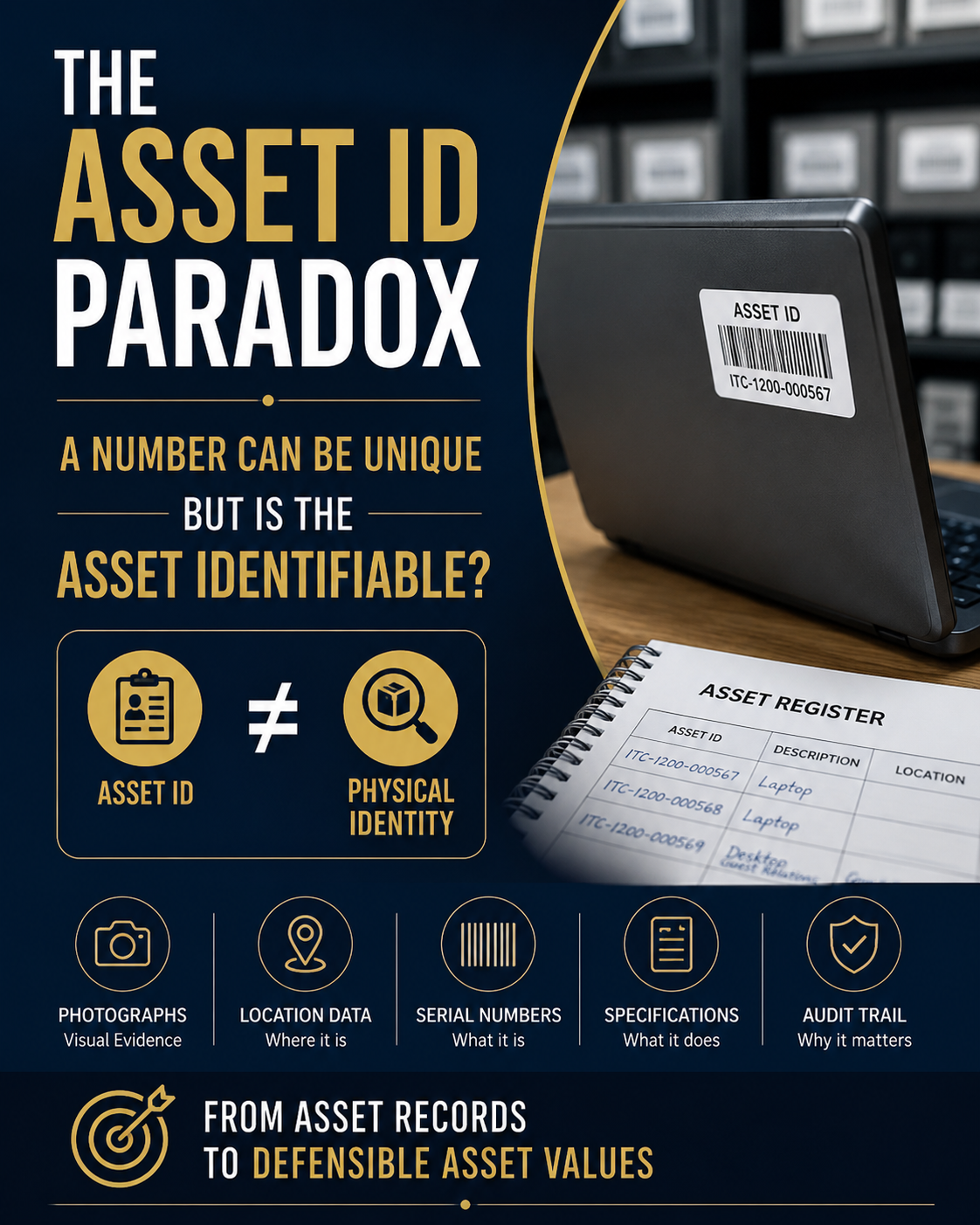
In fixed asset management, we often assume that assigning an Asset ID solves the identification problem.
.
It certainly helps.
.
But does it completely solve it?
.
Consider a simple example.
.
Suppose an organization owns 100 identical laptops purchased in the same year.
.
Each laptop may have a unique Asset ID.
.
From an accounting perspective, the assets are unique.
.
But from a physical verification perspective, can we confidently identify which laptop is which?
.
The challenge becomes even more interesting when we move beyond laptops.
.
Consider furniture, televisions, air conditioners, network switches, desktop computers, or hundreds of similar guest room assets in a hotel.
.
The Asset ID may be unique.
.
The physical appearance may not be.
.
This is where many organizations discover a gap between:
.
Asset Identity
and
Asset Identifiability
.
An Asset ID answers:
Which record is this?
.
Physical verification attempts to answer:
Which physical asset is this?
.
Those are not always the same question.
.
The larger the organization, the greater the challenge.
.
Over time, assets are relocated, upgraded, repaired, replaced, grouped, or described in generic terms.
.
The accounting record remains.
.
The physical trail becomes weaker.
.
This does not mean existing systems are wrong.
.
Far from it.
.
Asset IDs remain essential.
.
They are the foundation of asset control.
.
The question is whether additional layers of evidence can strengthen the connection between the record and the physical asset.
.
Photographs.
.
Location records.
.
Manufacturer and model information.
.
Serial numbers.
.
Specification data.
.
Together, these create a richer audit trail.
.
In the end, effective asset management is not merely about assigning a unique number.
.
It is about creating sufficient evidence so that the asset can still be understood, identified, and defended years later.
.
Especially when the information is needed most.